Sunday, March 20
We landed in Ushuaia at about 3pm and were welcomed by an unusually warm autumn afternoon. Ushuaia is the (debated) southernmost city in the world (Chile claims Puerto Williams is but PW is more of a town with 2,000 people while Ushuaia has 70,000). At the 54th parallel south, cold temperatures and high winds are persistent year-round. In summer, the average high temperature is 55F. So when we showed up to low 60s with clear skies and high winds, it was nearly magical.
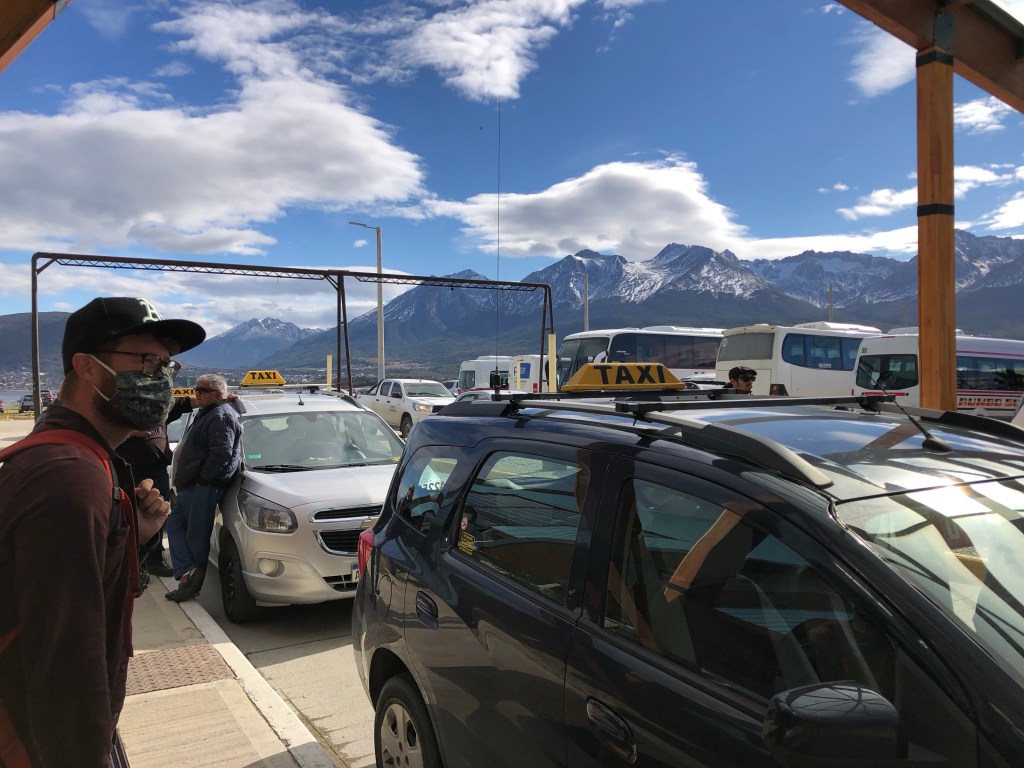
We got a taxi directly to our hostel, Antartica Hostel. Perhaps because Ushuaia is one of the five gateway cities to the Antarctic, the tourism industry seems geared toward that venture and therefore toward the wealthier more so than the backpacker. To save some pesos we opted to sleep in single beds in mixed dorms for the week. Even though this hostel was even nicer than expected we’ve decided to get airbnbs for the next two places in Argentina because it turns out I’m too old and tired to be sharing a room with 5 other strangers, let alone a kitchen with 20.
The hostel gave us sheets and towels and showed us to our dorm. Carl and I were both given top bunks. I went ahead and made my bed and we went back downstairs to ask reception about booking day trips. When I came back to my bed I noticed my pillow and blanket were wet. I looked up to the ceiling and saw a water spot. When I touched it, more water dripped out. To the hostel’s credit, they quickly responded and let me change beds immediately. I was moved to another room, away from Carl, but with a bottom bunk. I guess the leak stopped because they ended up putting a new person in my old bed while I remained content with my bottom bunk surrounded by strangers.
With daylight fading away we decided to walk around the town and enjoy the nice weather. It was sunny with temperatures in the low 60s. We hadn’t eaten all day so I demanded we get a nibble before I fainted whilst walking around. Of course we were searching for food at the exact wrong time of the day. All the restaurants here do a late lunch and late dinner and are generally closed from 4-7pm. We were able to find a cafe, Cafe Van Gogh, that offered to make small items so we got some bruschetta toast with salmon and a couple beers to fill us up. The bruschettas were good but overpriced.
With bellies satisfied we walked around the town and took photos of the town sign and the beautiful mountains encircling the city.

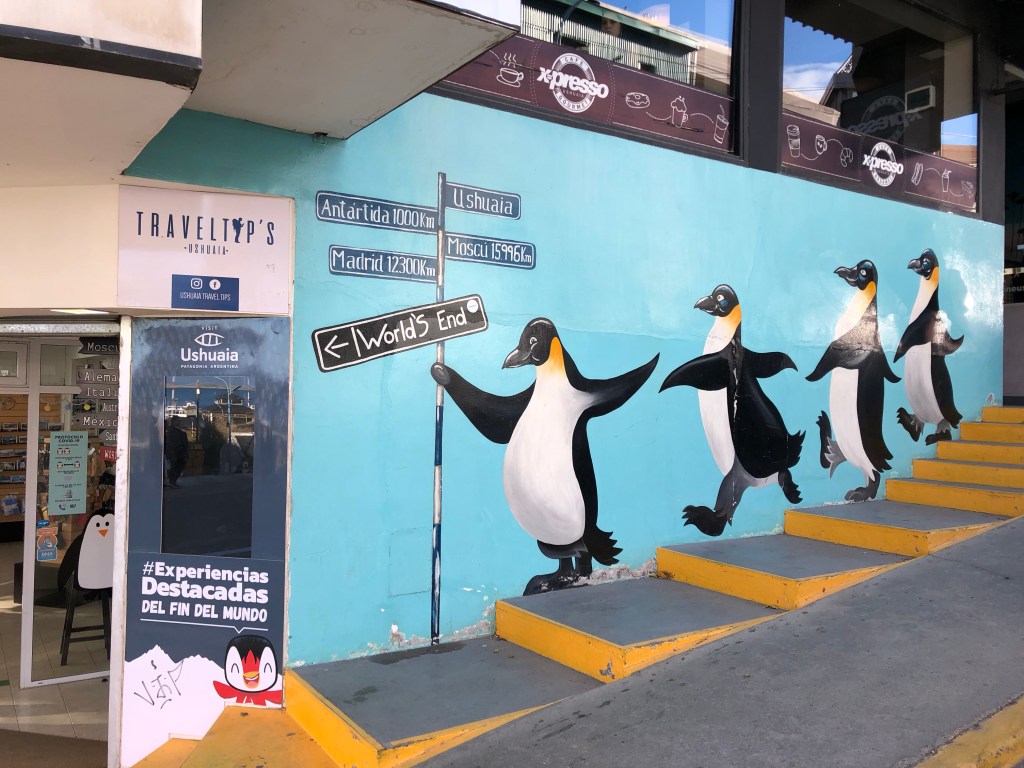

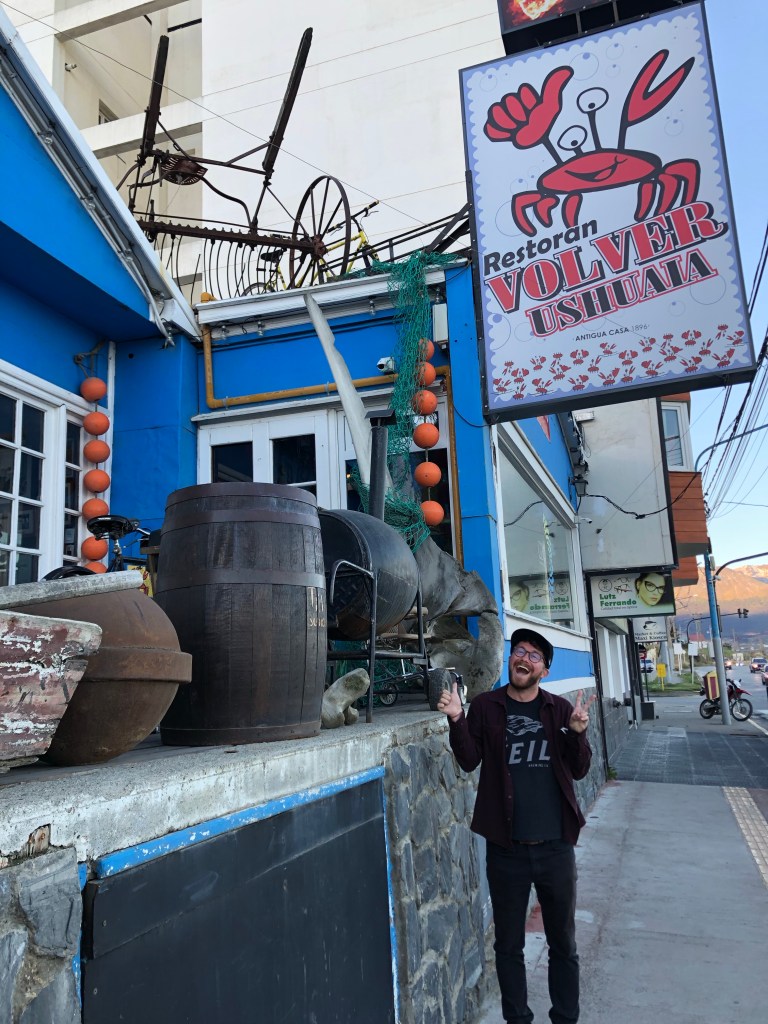
Eager for dinner we walked up to a seafood place called Volver that we had read reviews for online. We went in just minutes after they opened at 7pm. There was just one waiter who was overwhelmed with the 3 tables that had sat all at once at 7 so it took a long time to get seated, get the menu, order, etc. We nearly dined and dashed because it took ages to get the check. We ordered the Ceviche de Puta Madre and the Garlic Sea Bass. The ceviche was spicier than average but was otherwise a little disappointing. The sea bass though -!!!- the skin was crunchy with garlic and the flesh was tender and flavorful, like butter of the sea. We don’t often order white fish so this was a very pleasant surprise. Quality seafood for too much money and served with bad service would prove to be a theme of our dinners in Ushuaia.
Monday, March 21
For our first full day in Ushuaia we opted to do a boat tour that cruises the Beagle Channel and the chance to see penguins. I wore my very warmest outfit with two sweaters and a puffy but made the mistake of only wearing one layer of thick leggings so ended up tying my scarf around my waist for some more layers over my very cold behind.

The catamaran left promptly at 9am and headed east along the Beagle Channel. We were immediately awed by the views of the encircling mountains. A guide spoke over the audio speaker in very clear, slow Spanish but still it was difficult to understand everything she said. We soon came upon an island of birds and sea lions (which are called sea wolves in Spanish). We thought the island was covered in black and white penguins but then realized they were Cormorants. Still cute, but not penguins.
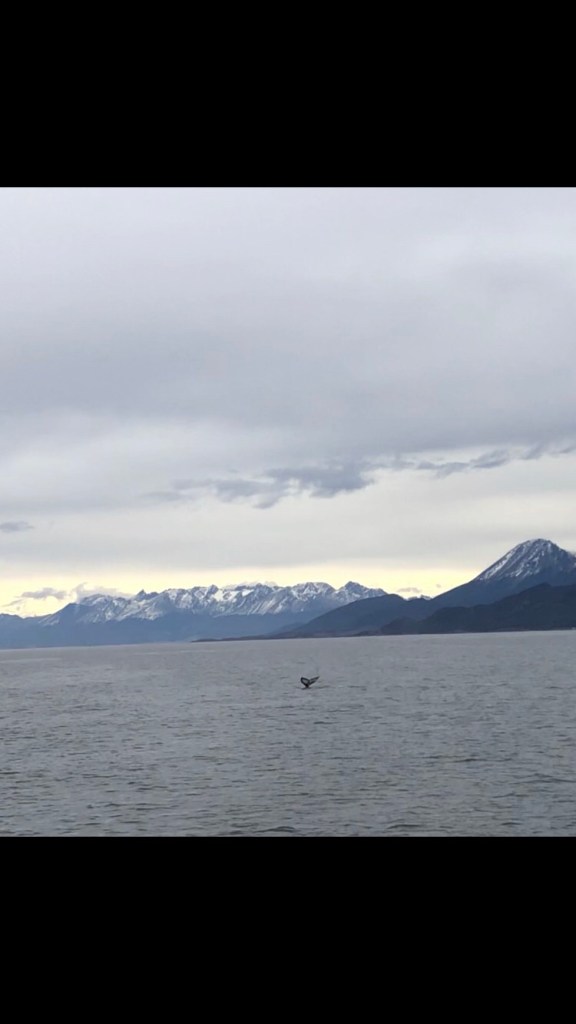
As the boat got moving again, Carl spotted something in the water that looked dolphin like. The creature blew air out of its blow hole and we realized it was a whale! The boat slowed down and we could see two whales, though we couldn’t tell what kind they were. I luckily caught a photo of a tail and we later identified it as a Minke whale (or so we think!). Not too long after I was sitting inside to get warm and Carl was out on the upper balcony when he spotted a huge whale surfacing right next to the boat. He pointed and said “oohhhahhh!!” the universal phrase for ‘look there’s something in the water!’. Again they slowed the boat almost to a stop. I came outside to take a photo and before I could get my camera on, the humpback whale leapt out of the water and rotated, showing us its belly before splashing onto its back-right next to our boat!! It was the most glorious moment. I was able to get a video of its tail just as it dove back into the deep again. Later I asked the guide if she could make an announcement to see whether anyone got a picture of the whale breaching but she dismissed me saying she was done announcing. I thought of asking everyone on the boat but my Spanish is just not good enough for that much convo so I settled with looking up photos on google later, vowing to never forget the mental image of such a close encounter.
After the whale leap (life was forever changed) the whole boat seemed to be unimpressed by other wildlife. We saw hoards of sea lions swimming next to us and we’d say, ‘oh it’s just sea lions again’. On the way back we saw a huge pod of dolphins and the boat slowed. The impressive thing was how many there were and how close to the boat they were. Plus, many of them seemed to be playing as they leapt out of the water, sometimes rolling over and landing on their backs.
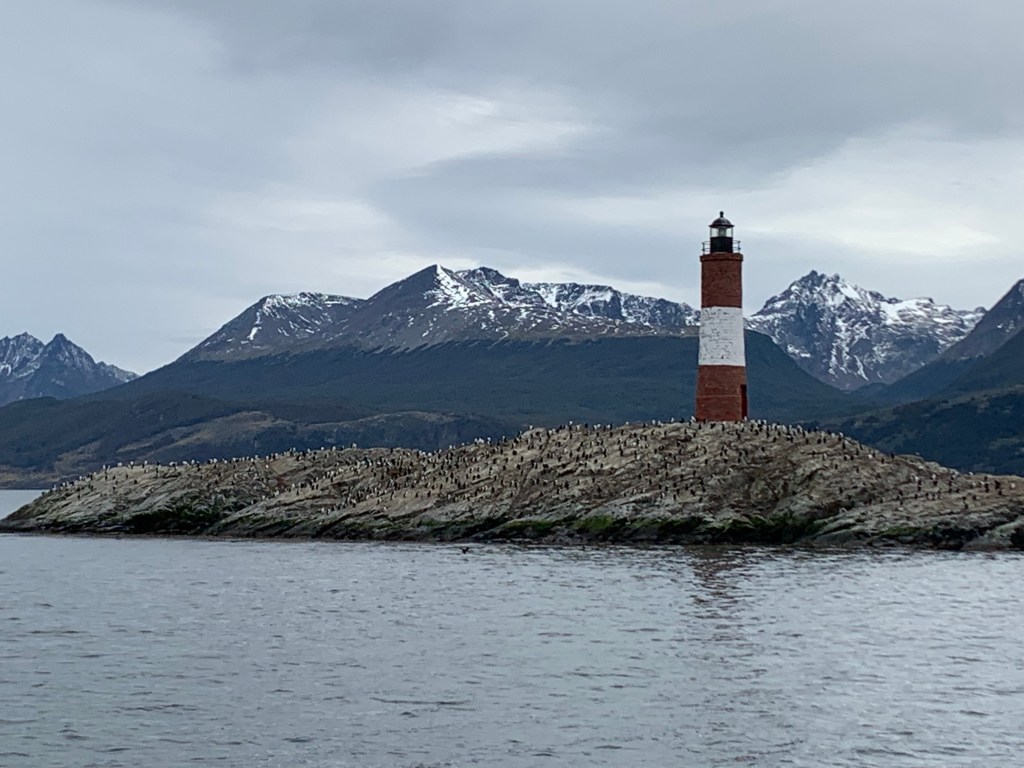
The boat came up to the Les Eclaireurs Lighthouse and stalled, allowing the professional photographer to take pictures of people on board. Then we finally made it to ‘penguin island’. We were so excited to see so many and then realized- they were all cormorants still! The guide announced that there were some penguins hidden in the crowd. It was like a game of Where’s Waldo to find the few penguins waddling around. We saw about ten Magellanic penguins and just two King penguins. The King penguins sat there stoically looking like, well, kings. Meanwhile the Magellanic penguins wandered around like single guys at a party, trying to not look like a loner while looking for their buddies.

After the penguins, the boat dropped people off in a town called Harberton. Such an English sounding town name was bestowed by Thomas Bridges who was a missionary and said to be the first white man to permanently settle in Ushuaia in the 1860s. Of the dozens of missionaries that came to Tierra del Fuego, Bridges actually learned the language of the indigenous people, the Yámana, and tried to create a written alphabet to document it. He was more successful with getting along with the Yámana than others before him had been. Still, most of the indigenous population was wiped out by diseases brought by these missionaries so there was not much of a population here- something that will matter for the story about the prison tomorrow.
For the boat ride back we bought some coffees and a dulce de leche pie that helped us warm up. We got into a conversation with the announcer and she chided us for not asking for English translations earlier on the ride and wouldn’t accept our defense that we didn’t know that was an option and would never assume it would be. But, for the rest of the way back she said everything in English and Spanish, so we were able to learn a little more about the area.
Upon docking back in Ushuaia in the early afternoon we decided to get a small bite but again realized it wasn’t great timing. Ironically most of the tours end in the afternoon so the Ushuaia tourism board would be wise to encourage more restaurants to stay open at this time. We were able to find a place that was open called Bar Ideal that advertised fast and cheap food (neither of which were true). We opted to share a bowl of crab sorrentinos. Sorrentinos are like raviolis but bigger and perfectly round. They were good and just the right size for a late lunch.
After we decided to walk to Club WU (western union) to try our luck with taking out just a bit more money to last us for the rest of Argentina. The big Club WU is on the other side of town in a French grocery store chain called Carrefour. When we got inside we balked at the line – about 15 people – and thought it unlikely we’d be able to get cash. While Carl waited in line I went shopping and got us some cheap items like floss, granola bars, etc. The challenge of having to use our limited cash in Argentina has made us extra budget conscious and I actually had fun looking for the cheapest version of everything- reminiscent of my poor days in FEMA Corps. By some luck, Carl was successful and we were able to get just a bit more cash, hoping it would last us until we flew out of Buenos Aires.
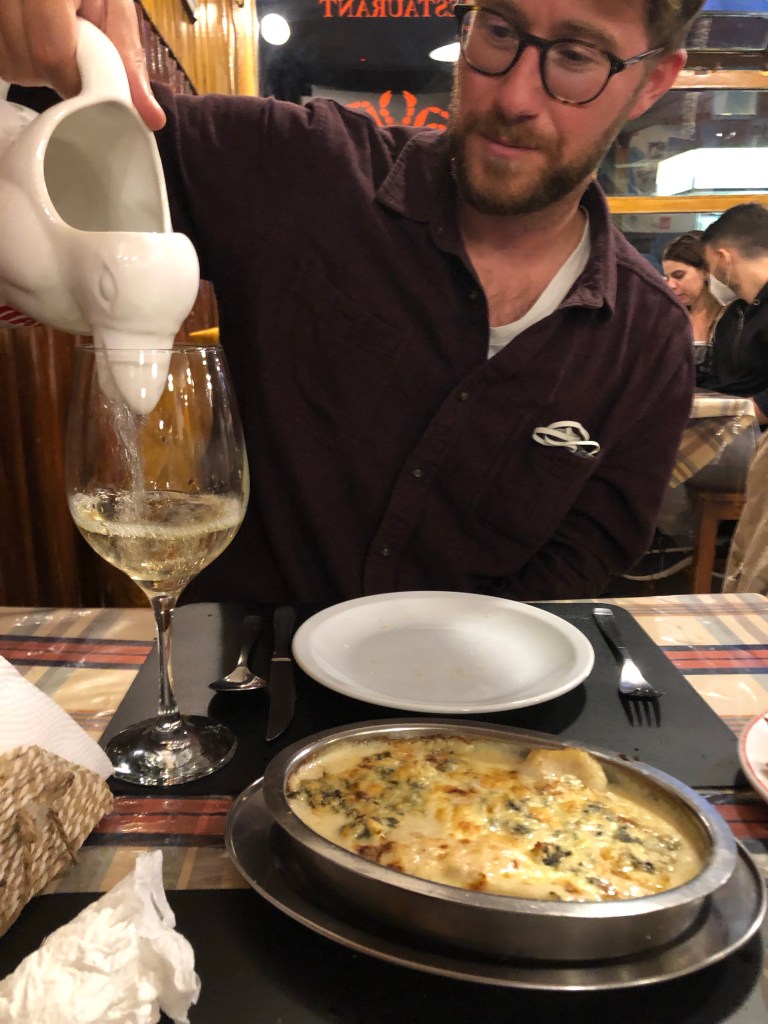
We walked back to the other side of town and to a restaurant called La Casa de Mariscos. They had just opened for the night and it was packed. The host had one two top open but she said we had to finish by 930 which was funny to us because we would normally never be eating that late anyways. Of course we finished on time but it took her so long to bring us the check. We probably waited for 30 minutes with dirty plates in front of us, again fantasizing about dining and dashing but knowing we would never because we believe too much in karma. We ordered calamari and Haddock de Roquefort which was basically just haddock baked in a blue cheese stew -AKA delicious. Best part of the meal may have been the cheap Chardonnay we ordered which came in an adorable penguin-shaped pitcher.
Tuesday, March 22
We started the day with a quick trip to the history museum which we heard was worthwhile. Turns out we went to the wrong one. The travel bloggers had raved about Galería Temárica which pairs history with life size figures demonstrating the historical scene such as prisoners building the railroad and people hunting and catching fish. The museum we went to was nice, a pretty standard small place history and natural history museum. We spent less than an hour and then walked back to our hostel to get a taxi.
We got a taxi to the Train at the end of the World train station. The railway was built by prisoners from the Ushuaia prison in order to access the interior forest of what is now the Tierra del Fuego national park. The prisoners would chop down trees to use as fuel to heat the prisons and other establishments in Ushuaia.
Ushuaia’s prison was established in 1902 with the intent of placing more Argentinians in the far south to hold their claim to the land. This sounded over the top to us but then we recognized the dispute over the Falkland islands was a hot simmering subject around this time, so Argentina was extra conscious of securing their land.
Given the extreme climate of Tierra del Fuego, it was difficult to convince people to move to this area willingly so Argentina settled with relocating prisoners, who didn’t have a choice. Plus the harsh environment of cold temperatures and strong winds added an extra element of torture to the prisoners’ repentance. The prisoners spent their time building the city of Ushuaia, which likely wouldn’t have existed without their hard labor.
The train station itself is adorable and somewhat kitschy. While we waited in line to board the train we could peek through a window into the workshop where workers fixed train parts. As we boarded men dressed in prisoners outfits posed with us for a photo. The man asked me to put him in a choke hold and the absurdity of it made us laugh so hard that our picture did not turn out well at all.
After the prison closed the railway was used for extracting resources for a little while longer until an earthquake hastened it’s dissolution into disrepair. In the 90s some bright person thought to revamp the railway into a tourism venture so the train now only runs along 7km of rail, from the train station into the national park and back.
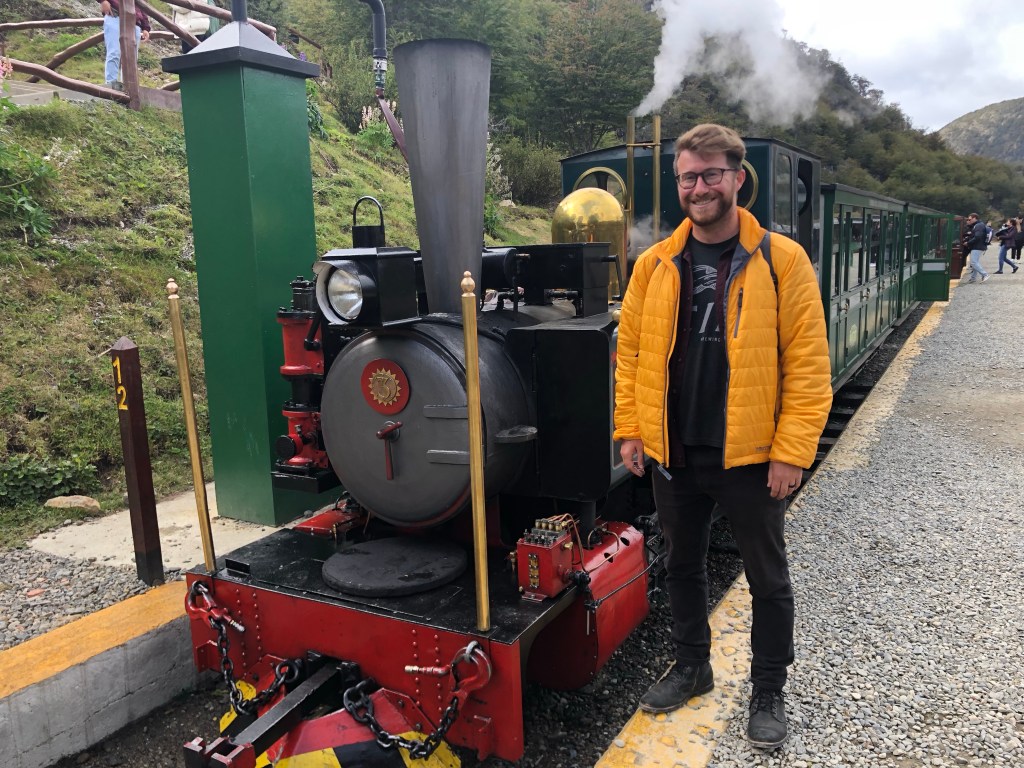
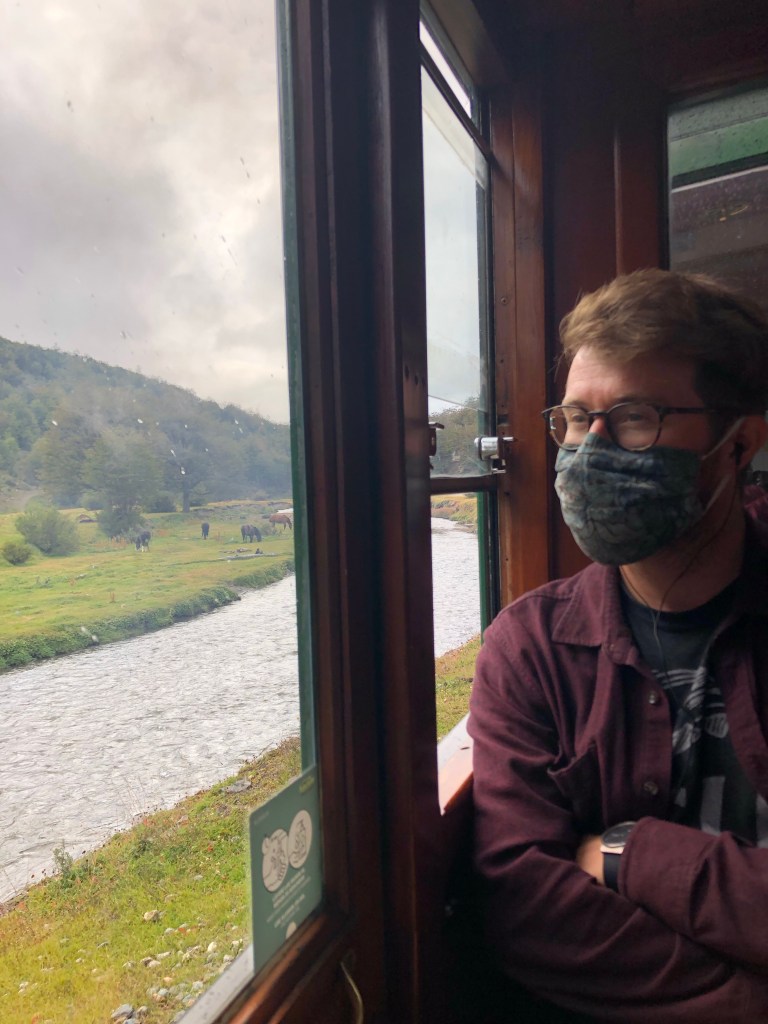
Our train, named Camila, was forest green and hobbit sized. We climbed aboard with two other people in our cabin and were given headphones to plug in and listen to audio guide in English. The first stop was at La Macarena station where we were given the opportunity to get out and take pictures. There was also a short hike to an underwhelming waterfall that all the train passengers crowded around taking photos of.

Then we ventured into the park. I was surprised the last stop had very little infrastructure. We got out and found a trail that led down to the water. We looked across the Beagle Channel to the small islands in the park and large mountains looming in the distance in Chile. It was forecasted to rain all day (hence our decision to take the train) but when we got to the shore it was only partly cloudy and nearly warm!
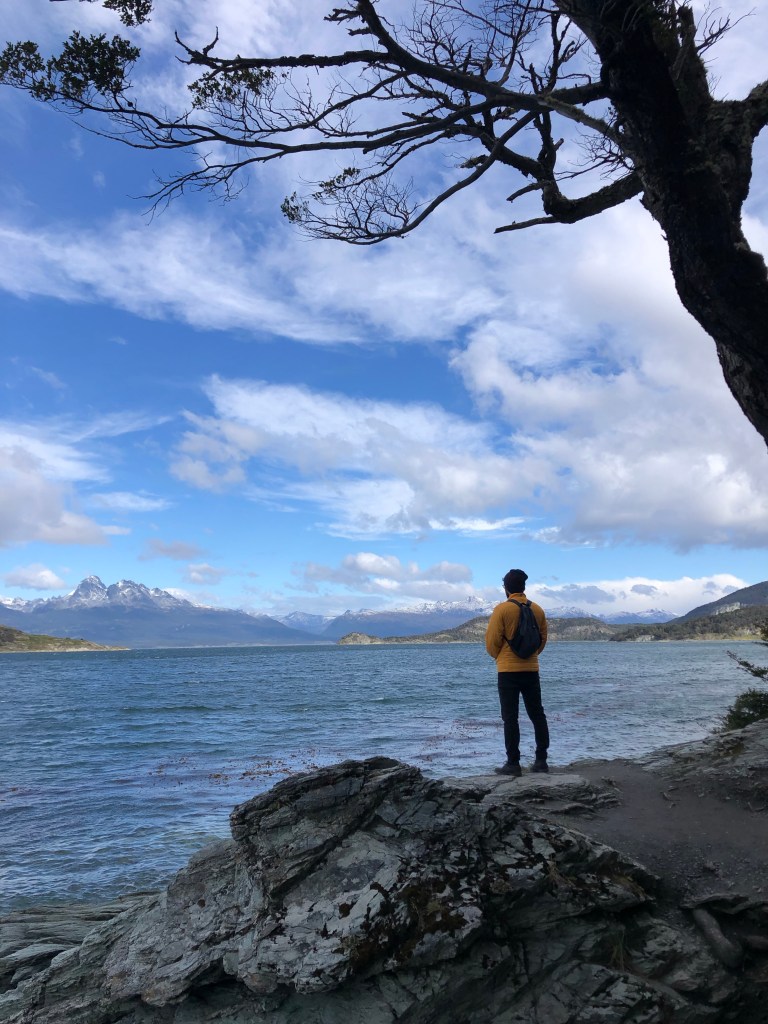
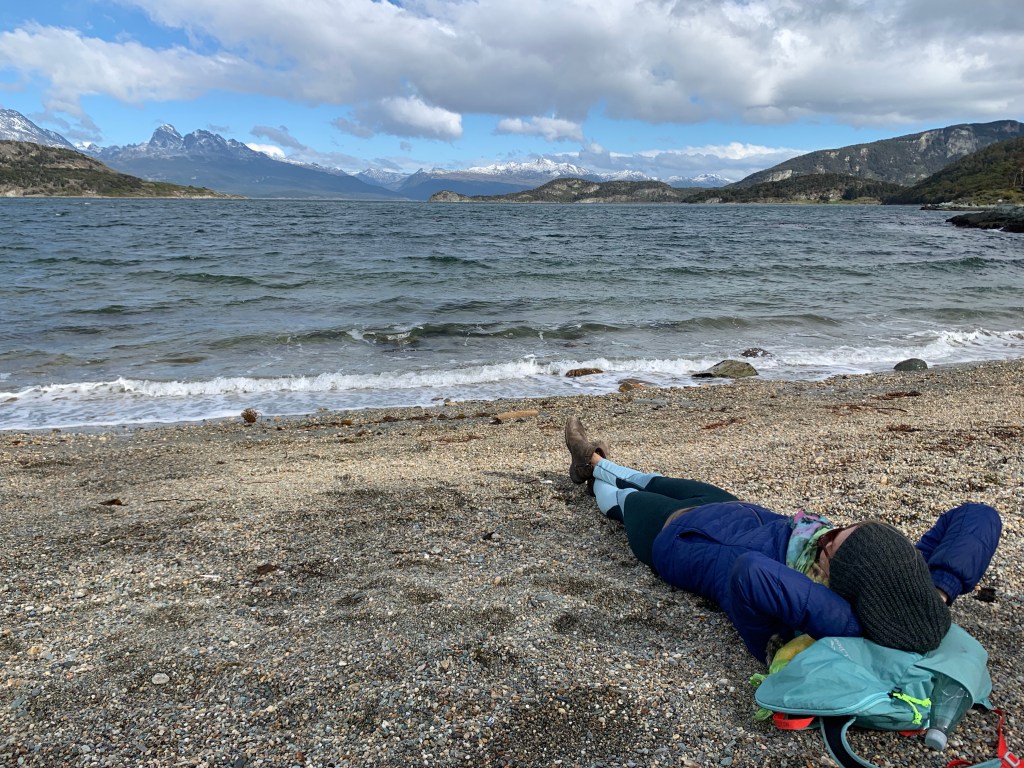
We walked along the coastal trail for a bit, admiring the mossy, gnarled, twisted trees that leaned precariously over the rocky bluffs. It reminded us of Monterey, CA. We had the option of walking along this trail for another 2 hours and getting a national park bus back to the entrance but without WiFi or enough snacks we opted to stick with what we already knew and walked back to the train.
The train goes three times a day. Some people stay on the train for both the forward and back journey. Most people take the train just one way and then meet up with tour guides to hike or stay in the park. We were amongst a handful of people that opted to get off the train, walk around a bit, and come back for the last return trip back to the station.
There were only a few people on the 3pm return trip but they still had an audio guide that described more about the park’s flora and fauna. We learned that beavers were introduced to the area to create a fur trade but the beaver population exploded out of control, without any natural predators in the area to keep the population in check. As the population exploded the beavers decimated large parts of the old growth forest. We saw beaver on a menu in one of the restaurants and I had been appalled but now realized it was helping reduce pests.
A shorter train ride back and we ended up at the main station again. We were able to have the office call us a cab back into town and we ended up sharing it with a guy named Glen who was from Kansas City but lives in Mexico doing nonprofit work. We ended up seeing Glen later in town and again on the trail the next day.
Back in town we redeemed vouchers for free hot chocolates that we had gotten with our train tickets. The hot cocoa wasn’t very good, but it was hot and free so we were happy.
For dinner we went to El Viejo Marino. They opened at 7pm and didn’t take reservations so we got there at 6:50 to try to secure a spot. There was a line in front that went all the way to the street corner. The restaurant is located on the street closest to the highway and waterfront so it was colder and windier out front. I questioned whether waiting in line would be worth it. Carl walked toward the front and asked whether the food was any good. Several people in line yelled back, emphatically, how good the food is and that it would be worth our wait. So we got in line. The doors opened just after 7 and to my surprise they let everyone in at once. They sat every table in the restaurant and we were the second to last table to secure a spot.
We decided to go big and get the king crab. They boil the whole thing and bring it out to you, letting you take pictures before they demonstrate how to open it using very sharp scissors. There was so much meat in the legs and it was good! Surprisingly they didn’t serve any butter or sauce so it was good the meat itself was so flavorful.
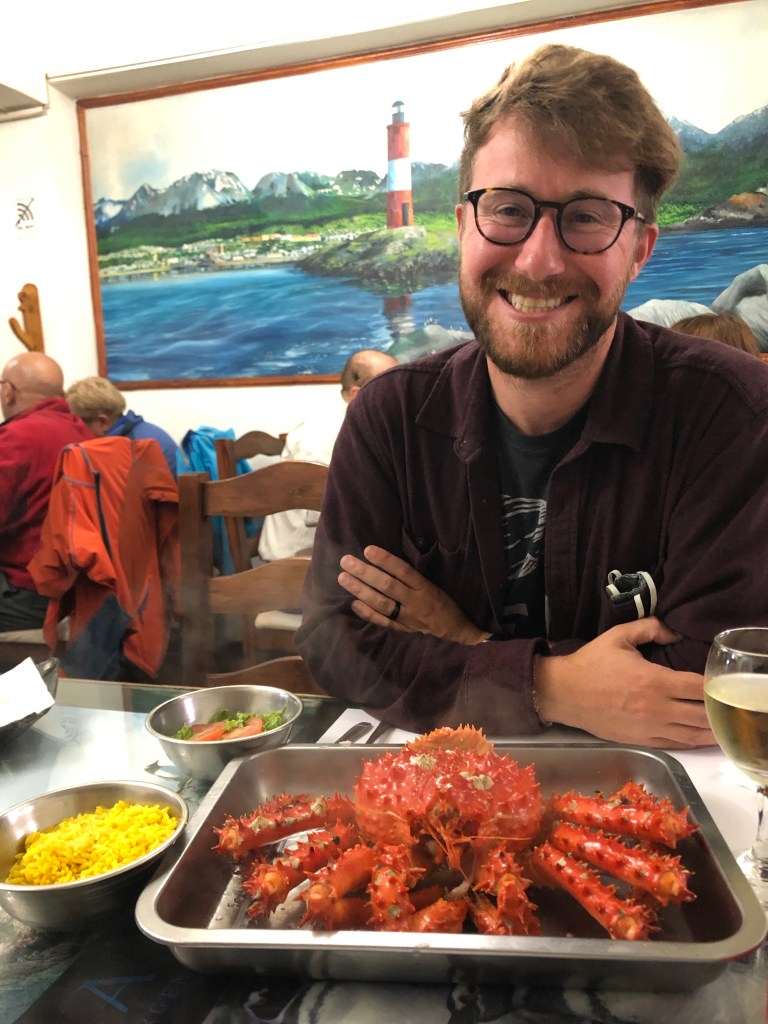
After successfully eating all the legs, we got to the body. Carl and I poked around, wondering if our Maryland crab opening skills would come in hand to help us look like we knew what we were doing. Wrong. The waiter quickly came over and cut the top of the crab open, exposing two sides of meat for us.
We had also ordered a seafood stew appetizer that was good, and the crab came with sides of rice and salad. The rice was undercooked and had no seasoning and the salad lettuce was wilted. Still, the fresh, flavorful crab meat overshadowed the rest of the meal, and we were satisfied.
That night we bought some cans of beers from the hostel front desk and we invited a couple of the guys in Carl’s dorm to play cards with us. One guy had food poising but the other, Rajiv, came out to the common area and sat with us. We ended up not playing cards and just talking -sharing travel stories and recommendations. We had heard Ushuaia was a fun place to party but at 11 we were all yawning so we went to bed, accepting our fate as the elderly hostel-goers we are.
Wednesday, March 23
At 10am we got a shuttle from the hostel to the trailhead for Lake Esmeralda. The shuttle driver loved his job, he was cranking Argentinian rock and pointing out all the pretty mountain views to us. He told us to be careful walking around the lake because the peat bog area could suck your foot down and steal your shoe.
At the start of the trailhead there were about 40 people starting the hike altogether. We went off trail slightly to get around the hoard and to avoid the biggest mud patches. The first 40 minutes of the hike was flat, walking through dense forest, and trying to avoid huge mud fields.

Eventually we broke into a valley and could see a range of beautiful, snow covered mountains ahead of us and behind us. Despite the colder temperatures, we were grateful to be in Patagonia for the fall season because we got to see the fall colors. Many of the trees in this valley were changing and the bright yellows and reds contrasted starkly with the cloudy sky and white and black mountains.
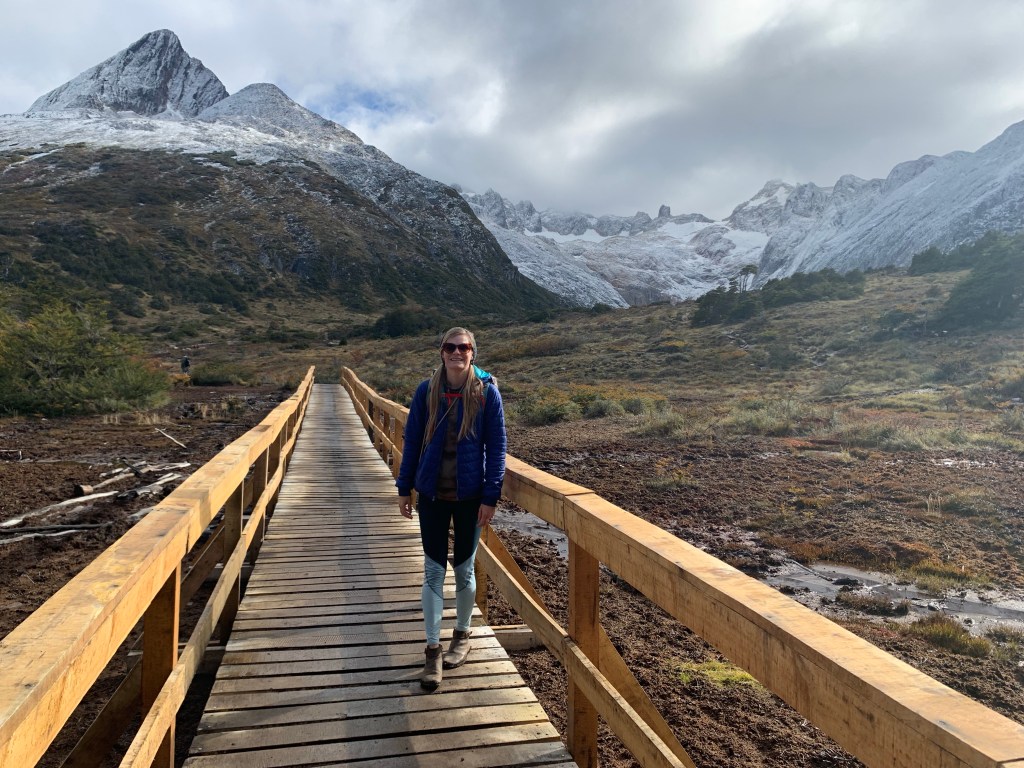
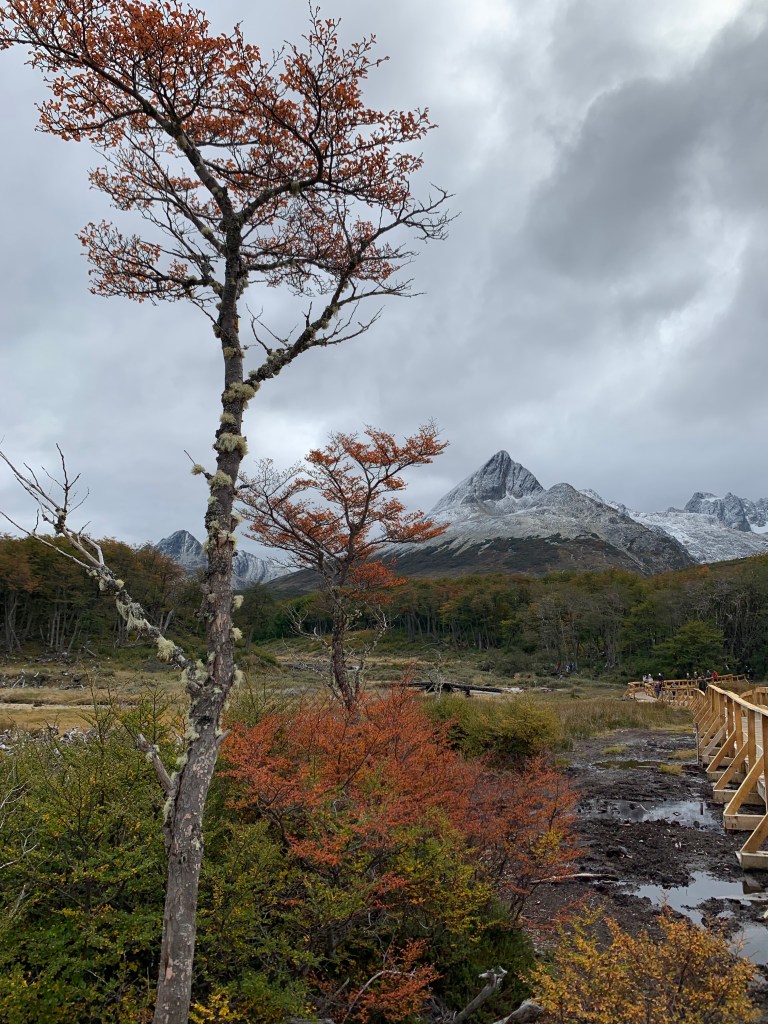
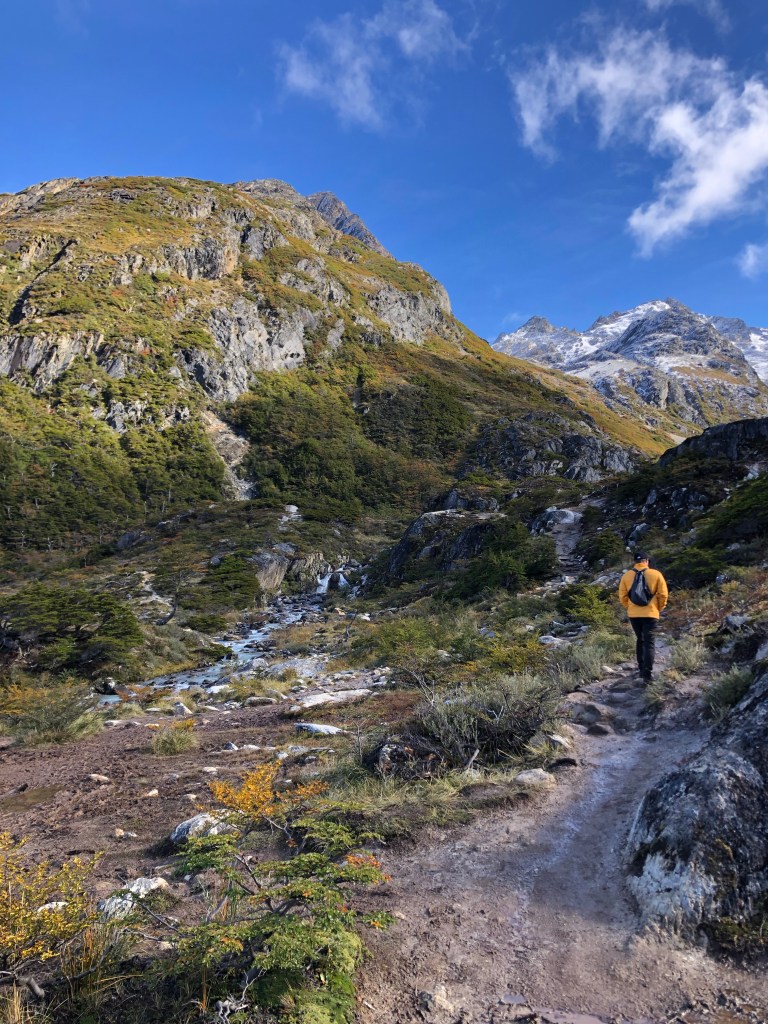
Across the valley we ascended a little before walking along a creek to reach the lake. Some areas had wooden boardwalks but much of the trail did not, leaving us to strategically plot our own way through giant mud fields and peat bogs. I made one wrong step and my foot sunk into the bog up to my ankle but luckily not into my boot.
As we reached the lake the sun came out and revealed the beautiful cloudy green color of the glacial water. We walked east around the lake to try and get the sun behind us. Given the extra time delay from mud hopping we decided not to go all the way around the lake (not sure if that would’ve been possible) and began our descent back down.
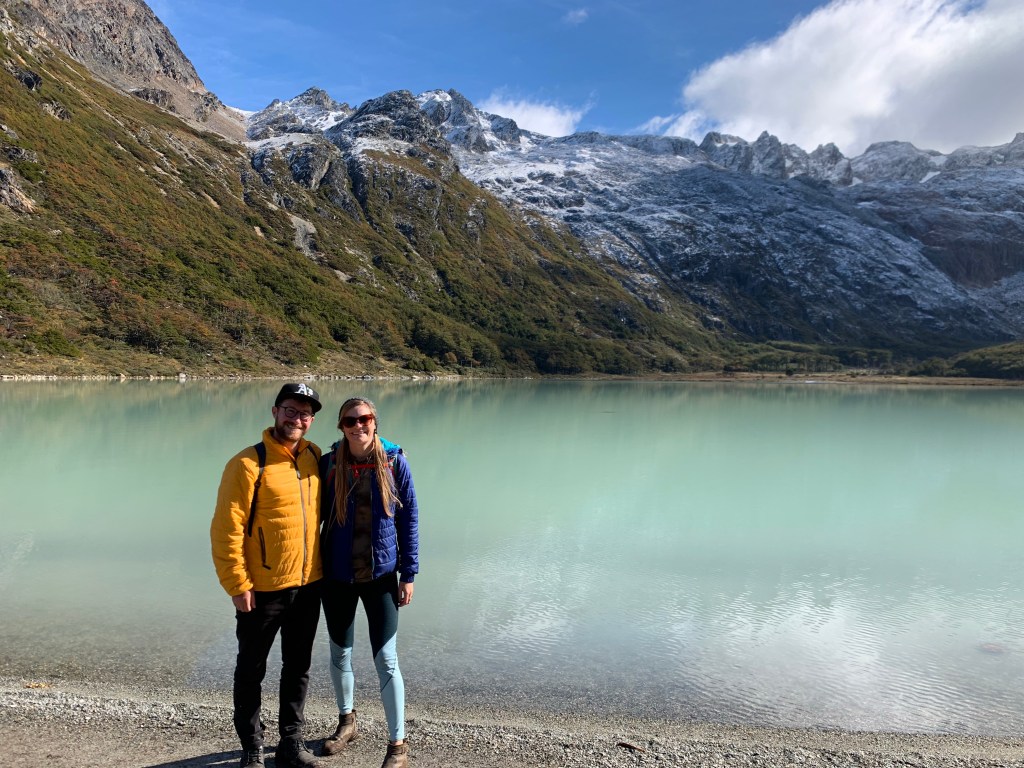
The way down we zoned out into rock hopping flow- avoiding mud patches but also not caring as much because we had seen the worst of it.
We got back to the parking lot at 230 with plenty of time before the 3pm shuttle back to town. Lo and behold there was a man in the parking lot who had a plastic table and a grill. He was making Choripán and hamburgers and the smell of grilled meat wafted across the parking lot, up the trail. We got two Choripanes for 400 pesos each and asked for all the toppings. He put a vinegary chimichurri sauce on top and it was so good that I went weak in the knees on my first bite. Carl took a photo of me eating but I looked terrible because my eyes were rolling back into my head with sheer joy and choripán amazement, so that photo was quickly deleted.
We got the shuttle back into town and decided to get some hot drinks to pass some time in the afternoon. Then we went back to the hostel for some WiFi time before going out to our last Ushuaia dinner.
That night we went to Parrilla La Estancia. Parrilla means grill and refers to a place that serves up big portions of grilled meat. As we walked inside we peered into the big glass windows to see grilled lamb roasting over an open wood flame. The butcher looked like he was having a great time as he pulled out huge chunks of meat and wailed away with his super sharp cleaver.

We got the lamb, a blood sausage and a side salad. The salad was unsurprisingly abysmal, as all sides at restaurants in Ushuaia had been. But the blood sausage was amazing. It was very obviously hand crafted in house, crumbling as we cut it open. The meat was well spiced and soft, like pudding.
But the lamb. Our waiter hooked us up with a giant order, so big we were concerned he had ordered us two portions rather than one to share as we asked for. They put two big chunks on our plate and we couldn’t tell which part of the animal they were. I pulled a bit that was hanging off the side and I nearly fell out of my chair because that little bit tasted so good. Carl thought something was wrong with me because I was acting so dramatic but then he tried a piece and did the exact same. We paired it with a bottle of the cheapest Malbec they offered (990 pesos so about $5.50 US dollars) and cheered to the great eats and great scenes of Ushuaia.
 Sharing our Traveler's Diarya